 |  |
The Independence Monument (Vimean Ekareach) was inaugurated in November 9, 1962 to celebrate Cambodia’s independence from foreign rule. Renowned Cambodian architect, Vann Molyvann was the architect of the monument. The Independence Monument now also serves as a monument to Cambodia’s war dead. It is the site of colorful celebrations and services on holidays such as Independence Day and Constitution Day.
National Museum
 | 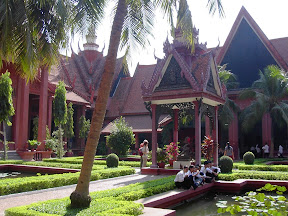 |
The distinctive rust-red National Museum next to the Royal Palace was dedicated by King Sisowath in 1920. Over 5000 objects are on display including Angkorian era statues, lingas and other artifacts, most notably the legendary statue of the ‘Leper King.’ Though the emphasis is on Angkorian artifacts, there is also a good collection of pieces from later periods, including a special exhibition of post-Angkorian Buddha figures.
Water Festival
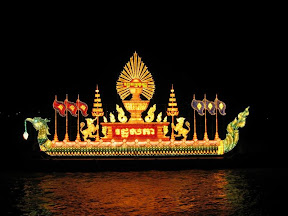 | 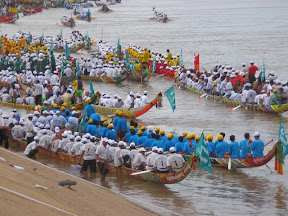 |
This annual festival is held in November (11-12-13 Nov but according to khmer lunar calendar) to celebrate the remarkable fact that the flow of the Tonle Sap River changes direction at about this time. The level of the Mekong rises so much at the end of the rainy season that water from this river is forced up into the Tonle Sap Lake some 100 kilometers inland from Phnom Penh. The festival itself has religious elements, but centers around three days of fireworks displays and traditional boat races on the river.
Royal Palace and ‘Silver Pagoda’
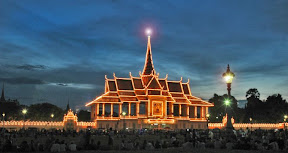 | 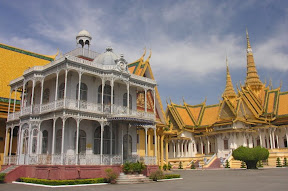 |
The Royal Palace in Phnom Penh was constructed in 1866 by His Masjesty Preah Bat Norodom to serve as the residence of the King of Cambodia. It serves to this day as the Cambodian home of King Norodom Sihamoni and former King Norodom Sihanouk. The Royal Palace complex and attached 'Silver Pagoda' compound consist of several buildings, structures and gardens all located within 500x800 meter walled grounds overlooking a riverfront park. Marking the approach to the Palace, the high sculpted wall and golden spired Chanchhaya Pavilion stand distinctively against the riverfront skyline. Inside the Palace grounds, street sounds are silenced by the high walls and the various Royal buildings sit like ornate islands rising from the tranquil, manicured tropical gardens. Except for the area of the actual Royal residence, the Khemarin Palace, most of the Palace grounds and Silver Pagoda are open to the public.
Wat Phnom
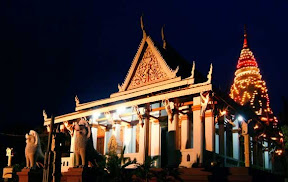 | 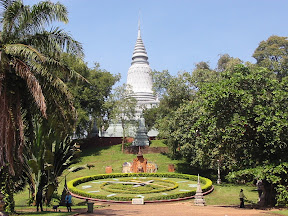 |
A small hill crowned by an active wat (pagoda) marks the legendary founding place of the Phnom Penh. The hill is the site of constant activity, with a steady stream of the faithful trekking to the vihear, shrines and fortune tellers on top, and a constellation of vendors, visitors. Elephant rides available. The legend of the founding of Wat Phnom is tied to the beginnings of Phnom Penh. Legend has it that in 1372 Lady Penh (Yea Penh) fished a floating Koki tree out of the river. Inside the tree were four Buddha statues. She built a hill and a small temple at what is now the site of what is now known as Wat Phnom. Later, the surrounding area became known after the hill and its creator, hence ‘Phnom Penh.’ The current temple was last rebuilt in 1926. The large stupa contains the remains of King Ponhea Yat (1405-1467) who moved the Khmer capital from Angkor to Phnom Penh in 1422. Look for the altar of Lady Penh between the large stupa and the vihear. She is said to be of particular help to women. Wat Phnom is the busiest pagoda in town the night of Chinese/Vietnamese New Year’s Eve.
Choeung Ek Memorial (The Killing Fields)
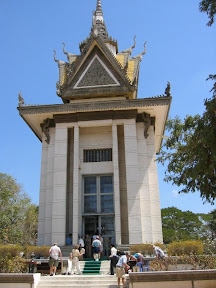
From April 17, 1975 until January 7, 1979, the ultra-Communist Khmer Rouge regime, led by Pol Pot, controlled the whole of Cambodia. Under the Khmer Rouge regime the country was known as ‘Democratic Kampuchea.’ During the short reign of the Khmer Rouge, between one million and two and a half million Cambodians perished, some killed outright, others dying from disease, malnutrition, neglect and mistreatment. Many of the dead ended up in various ‘killing fields’ that can be found scattered across the country. The killing fields were essentially ad hoc places of execution and dumping grounds for dead bodies. The memorial at Choeung Ek just outside Phnom Penh was an orchard and a Chinese cemetery prior to 1975. During the Khmer Rouge regime it became one of the killing fields - this particular killing field is the site of the brutal executions of more than 17,000 men, women and children, most of whom first suffered through interrogation, torture and deprivation in the S-21 Prison (Toul Sleng) in Phnom Penh. Choeung Ek is now a group of mass graves and a memorial stupa containing thousands of skulls. It’s about a 20-40 minute drive from the center of Phnom Penh. There are guides available at the site, and a small souvenir shop. For sake of historical context, combine your trip to Choeung Ek with a visit to Toul Sleng Genocide Museum.
Toul Sleng Genocide Museum (S-21)
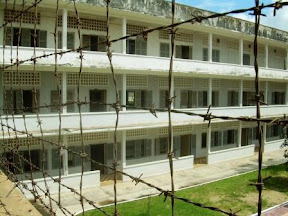 | 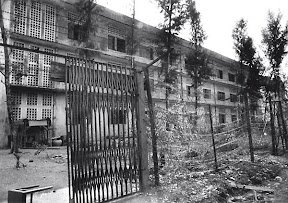 |
Prior to 1975, Toul Sleng was a high school. When the Khmer Rouge came to power it was converted into the S-21 prison and interrogation facility. Inmates were systematically tortured, sometimes over a period of months, to extract confessions, after which they were executed at the killing fields of Choeung Ek. S-21 processed over 17,000 people, seven of whom survived. The building now serves as a museum, a memorial and a testament to the madness of the Khmer Rouge regime. Much has been left in the state it was when the Khmer Rouge abandoned it in January 1979. The prison kept extensive records, leaving thousands of photos of their victims, many of which are on display.
Central Market (Psah Thmei)
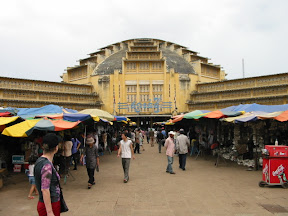 | 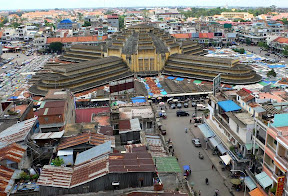 |
This unique, art-deco building is a Phnom Penh landmark. Prior to 1935 the area was a swamp/lake that received the runoff during the rainy season. The lake was drained and the market constructed in 1935-37. Wet season flooding in the area around the market of the market is a vestige of the old lake. The entrance to the market is lined with souvenir merchants hawking everything from T-shirts and postcards to silver curios and kramas. Inside is a dazzling display of jewels and gold. Electronic goods, stationery, secondhand clothes and flowers are also in ample supply.
Russian Market (Psah Toul Tom Poung)
This market is of far less architectural interest but has a larger and more varied selection of souvenirs, curios and silks than the Central Market. Like the Central Market, it has a good selection of silver, gold and jewels, but also carries huge selection of curios, silks, carvings, etc. The Russian Market offers the largest selection of bootlegged VCDs, DVDs and CDs of all of the traditional markets. It’s also a good place to buy fabric for business and casual cloths to take to the tailor. Most of what the visitor might want is in the same general area on the south side but the rest of the market is well worth exploring. Food and drink stands in the middle of the market for hygienically adventurous visitors.
Ta Prohm
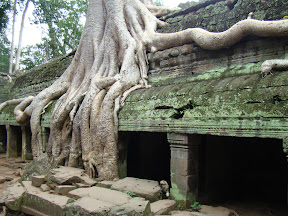 | 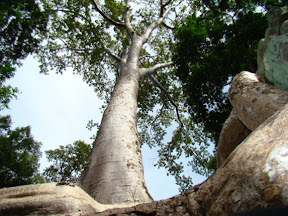 |
Is the modern name of a temple at Angkor, Cambodia, built in the Bayon style largely in the late 12th and early 13th centuries and originally called Rajavihara. Located approximately one kilometre east of Angkor Thom and on the southern edge of the East Baray near Tonle Bati, it was founded by the Khmer King Jayavarman VII as a mahayana Buddhist monastery and university. Unlike most Angkorian temples, Ta Prohm has been left in much the same condition in which it was found: the photogenic and atmospheric combination of trees growing out of the ruins and the Jungle surroundings have made it one of Angkor's most popular temples with visitors.
Banteay Srei (or Banteay Srey)
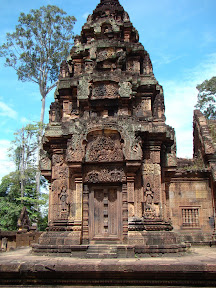 | 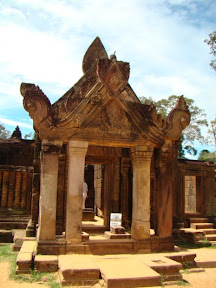 |
Is a 10th century Cambodian temple dedicated to the Hindu god Shiva. Located in the area of Angkor in Cambodia, at 13.5989 N, 103.9628 E, it lies near the hill of Phnom Dei, 25 km (15 miles) north-east of the main group of temples that once belonged to the medieval capitals of Yasodharapura and Angkor Thom. Banteay Srei is built largely of red sandstone, a medium that lends itself to the elaborate decorative wall carvings which are still observable today. The buildings themselves are miniature in scale, unusually so when measured by the standards of Angkorian construction. These factors have made the temple extremely popular with tourists, and have led to its being widely praised as a "precious gem", or the "jewel of Khmer art.
The Bayon
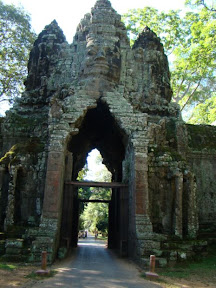 | 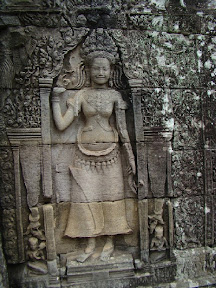 |
Is a well-known and richly decorated Khmer temple at Angkor in Cambodia. Built in the late 12th century or early 13th century as the official state temple of the Mahayana Buddhist King Jayavarman VII, the Bayon stands at the centre of Jayavarman's capital, Angkor Thom. Following Jayavarman's death, it was modified and augmented by later Hindu and Theravada Buddhist kings in accordance with their own religious preferences. The Bayon's most distinctive feature is the multitude of serene and massive stone faces on the many towers which jut out from the upper terrace and cluster around its central peak. The temple is known also for two impressive sets of bas-reliefs, which present an unusual combination of mythological, historical, and mundane scenes.
Phnom Bakheng
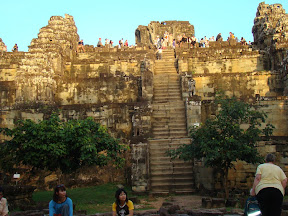 | 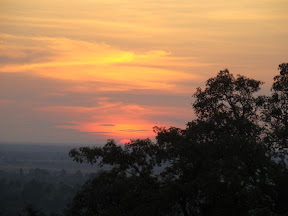 |
Is a Hindu temple in the form of a temple mountain. Dedicated to Shiva, it was built at the end of the 9th century, during the reign of King Yasovarman (889-910 A.D.). Located atop a hill, it is nowadays a popular tourist spot for sunset views of the much bigger temple Angkor Wat, which lies amid the jungle about 1.5 km to the southeast. The large number of visitors makes Phnom Bakheng one of the most threatened monuments of Angkor. Constructed more than two centuries before Angkor Wat, Phnom Bakheng was in its day the principal temple of the Angkor region, historians believe. It was the architectural centerpiece of a new capital, Yasodharapura, that Yasovarman built when he moved the court from the capital Hariharalaya in the Roluos area located to the southeast.
Tonle Sap
 |  |
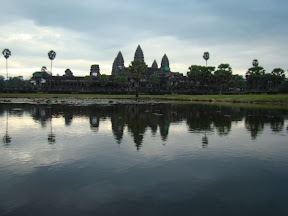 | 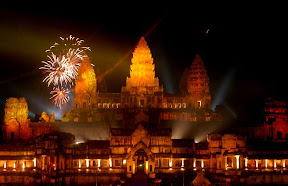 |
Is a temple built for King Suryavarman II in the early 12th century as his state temple and capital city. The largest and best-preserved temple at the site, it is the only one to have remained a significant religious centre since its foundation—first Hindu, dedicated to Vishnu, then Buddhist. The temple is the epitome of the high classical style of Khmer architecture. It has become a symbol of Cambodia, appearing on its national flag, and it is the country's prime attraction for visitors.
Angkor Wat combines two basic plans of Khmer temple architecture: the temple mountain and the later galleried temples. It is designed to represent Mount Meru, home of the gods in Hindu mythology: within a most and an outer wall 3.6 km long are three rectangular galleries, each raised above the next. At the centre of the temple stands a quincunx of towers. Unlike most Angkorian temples, Angkor Wat is oriented to the west; scholars are divided as to the significance of this. The temple is admired for the grandeur and harmony of the architecture, its extensive bas-reliefs and for the numerous devatas adorning its walls.
Beach
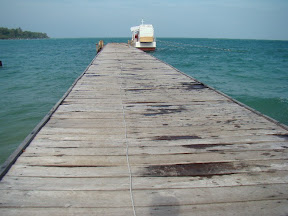 | 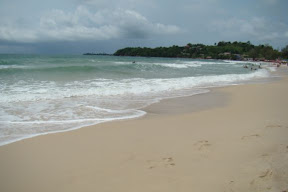 |
Sihanoukville is on a small peninsula with beaches and tropical islands off its south and west coast and the commercial port to the north west. Beaches that line the west contour of the city from north to south are Victory Beach, Lamherkay Beach, Koh Pos Beach, Independence Beach, Sokha Beach, Serendipity Beach, Occheuteal Beach and Otres Beach. The most popular beaches are Occheuteal, Sokha, Independence and Victory. Tourists can take water taxis to the nearby islands for diving, snorkeling, and game fishing.
Kratie (Irrawaddy Dolphin)
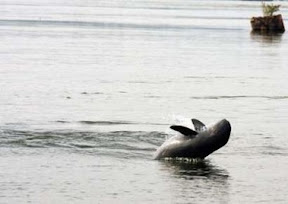 | 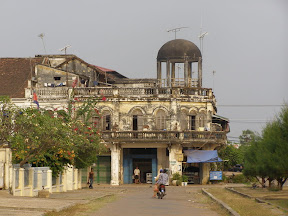 |
The city lies on the banks of the Mekong River. This stretch of river is home to a group of rare Irrawaddy dolpins. The dolphins are the town's main tourist attraction. The Mekong Dolphin Conservation project estimates that there are only 170 dolphins left in the upper Cambodian Mekong area. The Irrawaddy Dolphin is a species of dolphin found near coasts and in estuaries in parts of south-east Asia.
Plateau (Ethnic Minority)
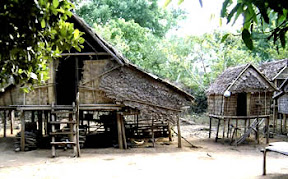 | 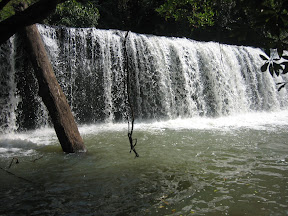 |
Ratanakiri is located on the north - east plateau , Its capital, Banlung, is located in the central highlands of the province, approximately 365 miles (586 kilometers) from Phnom Penh. It is bordering Vietnam on the east, Laos PDR on the North, Steung Treng on the West and Mondul Kiri on the South. The two main draws that bring tourists to Ratanakiri are its indigenous people groups and its wildlife. The province is home to five main ethnic minority groups, the Tampuan, Krung, Jarai, Kachak, and Baro/Kavet. Their tribal lifestyle and village culture are a popular attraction to tourists from every where. Besides the indigenous people groups there are many of beautiful water wall, rain forests...espacialy Yak Lom lake Located approximately 3 miles (4.8 kilometers) from the town center, the beautiful lake is the caldera of a large volcanic crater. Due to the lake’s tremendous depth (157 feet/48 meters), its water is exceptionally clean and clear. The lake is almost perfectly round and measures .45 of a mile (.75 kilometer) in diameter. Large trees and rich, the home of many parrots and other exotic birds, surround the lake.
Preah Vihear
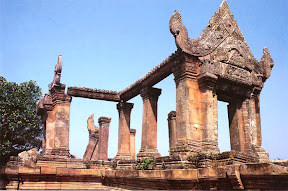 | 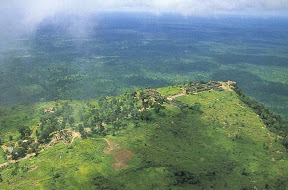 |
Is a Khmer temple situated atop a 525-meter cliff in the Dângrêk Mountains in Cambodia just across the border from Thailand. Affording a view for many kilometers across a plain, it has the most spectacular setting of all the temples built during the six-century-long Khmer Empire. As a key edifice of the empire's spiritual life, it was supported and modified by successive kings and so bears elements of several architectural styles. The temple gives its name to Cambodia's Preah Vihear province, in which it is located.
